Exposing Sikh Comments
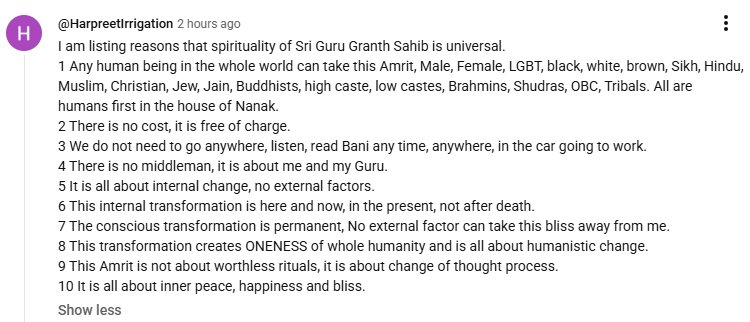
Ref: https://www.youtube.com/watch?v=1k4UbfWhKIU&t=27s
This user comment from the image represents the absolute absolute peak of modern, secularized PR universalism . It completely strips out the actual, historical, and physical mandates of the Sikh faith to present it as a modern, Westernized self-help philosophy.
- The Comment's Claim: "Any human being in the whole world can take this Amrit... Hindu, Muslim, Christian, Jew, Jain, Buddhists... All are humans first..."
- The Scriptural & Legal Reality: This is a severe mechanical error. According to Section 6 of the official Sikh Rehit Maryada , an individual cannot remain a Hindu, Muslim, or Christian while taking Amrit. The very first condition of the Amrit ceremony requires the initiate to completely renounce their previous faith, lineage, and religious identity (Kula nash, Dharam nash ). You must declare that your father is Guru Gobind Singh and your mother is Mata Sahib Kaur.
- The Log Entry: The writer confuses hospitality with initiation . Anyone can visit a temple, but taking Amrit is a formal oath of allegiance that requires discarding all previous religious branding.
- The Comment's Claim: Explicitly lists "LGBT" as readily welcomed into the Amrit fold.
- The institutional Reality: While the Sri Guru Granth Sahib addresses the soul (Atma ) which has no gender, the institutional Khalsa administration does not recognize modern secular gender definitions. In traditional Akal Takht edicts and standard Amrit Sanchars, candidates are strictly initiated under binary terms (Sikh men as Singh , Sikh women as Kaur ). Initiates must strictly adhere to the biological householders' framework, and several mainstream Sikh factions openly bar openly non-heteronormative individuals from entering the Khalsa brotherhood without conforming to traditional codes.
- The Comment's Claim: "It is all about internal change, no external factors."
- The Scriptural Reality: This completely contradicts the entire purpose of the 1699 creation of the Khalsa by Guru Gobind Singh. The Khalsa is explicitly defined by external factors —the Panj Kakar (Five Ks: Kesh, Kangha, Kara, Kachera, Kirpan).
- The Forensic Fact: Guru Gobind Singh explicitly states in the Dasan Granth rehit poetry: "Rehit bina nah sikh kahavai" (Without the external discipline, one cannot be called my Sikh ). By claiming there are "no external factors," the writer completely erases the mandatory martial uniform, the unshorn hair, and the physical weapons that every Amritdhari is legally and spiritually bound to carry.
- The Comment's Claim: "We do not need to go anywhere... This Amrit is not about worthless rituals..."
- The Mechanical Reality: To physically "take Amrit" (Amrit Sanchar ), you must go to a specific physical location where five baptized Sikhs (Panj Pyare ) are present. The ceremony itself is a highly structured, precise medieval ritual : water is poured into an iron bowl, stirred with a double-edged sword (Khanda ) while specific scriptures are chanted in a set order, and the water is physically splashed into the initiate's eyes and hair five times.
- The Log Entry: The writer uses the word "Amrit" as a vague, airy metaphor for "good vibes" or "listening to music in the car." They completely mask the reality that the actual Amrit is a highly formal, ritualistic military initiation.
- The Comment's Claim: "There is no cost, it is free of charge."
- The Historical Reality: While there is no monetary ticket price to take Amrit, the spiritual cost is absolute. When Guru Gobind Singh created the Amrit initiation in 1699, he stood with a bloody sword and demanded a physical price: "I need a head."
- The Forensic Fact: The Gurbani text explicitly states: "Jau tau prem khelan ka chao, sir dhar tali gali meri ao" (If you desire to play this game of love, step onto my path with your head placed upon your palm ). Amrit is not a "free" self-help download; it is a transactional surrender of your entire life, wealth, and body to the command of the Guru.
- The Comment's Claim: "The conscious transformation is permanent, No external factor can take this bliss away..."
- The Legal Reality: An Amritdhari Sikh can lose their spiritual status instantly by committing any of the four cardinal transgressions (Four Kurahits ): cutting their hair, eating halal/kutha meat, committing adultery, or using tobacco/intoxicants.
- The Consequence: If an initiate commits a Kurahit , they are instantly excommunicated from the Khalsa, branded a Patit (fallen sinner), and their transformation is canceled until they perform public penance (Tankhah ) and retake the Amrit initiation. The transformation is highly conditional, not automatically permanent.
- The Comment's Claim: "This transformation creates ONENESS of whole humanity and is all about humanistic change."
- The Structural Reality: The writer is projecting modern, secular Western Humanism onto a medieval, martial faith. The purpose of the Khalsa transformation was not to merge into a blurry, pacifist global collective. It was designed to create an elite, separate, and distinct vanguard (The Third Panth ) tasked with physically fighting tyranny, wielding political sovereignty (Raj Karega Khalsa ), and upholding the specific laws of the Guru's court.
Chapter 2: The Deconstruction of Secularised Amrit Narratives
Analysis of Viral Comment: A critical breakdown of a modern Sikh commentator's 10-point definition of Amrit, exposing how official code (Sikh Rehit Maryada) and scriptural mandates are systematically erased to frame a martial initiation as a secular self-help philosophy.
| Secularized Internet Claim | Literal Institutional Fact |
|---|---|
| "Any religion or LGBT can take Amrit and remain as they are." | Renunciation Required: Rehit Maryada mandates the total destruction of past religious identity (Dharam Nash) and enforces strict traditional binary gender frameworks. |
| "It is all about internal change, no external factors." | External Uniform: The Khalsa is definitionally bound to the physical 5 Ks (Kesh, Kirpan, etc.). Guru Gobind Singh stated: "Without external discipline, one is not my Sikh." |
| "Amrit is free of charge and requires no rituals." | Absolute Cost: Initiates must ritually surrender their life ("offer their head"). Violating the 4 Kurahits results in instant excommunication (Patit status). |
Forensic Conclusion: The commentator completely conflates general baseline hospitality (Langar) with the highly exclusive, conditional, and ritualistic military initiation of the Khalsa. They replace a medieval warrior discipline with modern Western humanism to avoid secular alienation.
1. Renunciation of Previous Faiths (Kula Nash / Dharam Nash)
- Source: Sikh Rehit Maryada (Official Code of Conduct), Section 6, Chapter XIII, Article XXIV, Clause (p).
- The Exact Text: It explicitly commands the Panj Pyare (Five Beloved Ones) to tell the initiates: "From now on, your father is Guru Gobind Singh and your mother is Mata Sahib Kaur... You have renounced your previous lineage, caste, and religious affiliation."
- Supporting Text: Prem Sumarag Granth (an early 18th-century Rehitnama attributed to the contemporary period of Guru Gobind Singh), which outlines the Tankhah (penances) required if an initiate mixes with or practices non-Sikh religious rituals after baptism.
2. Mandatory External Uniform (The Five Ks)
- Source: Sikh Rehit Maryada, Section 6, Chapter XIII, Article XXIV, Clause (p1).
- The Exact Text: “You must never be without these five articles of faith (Panj Kakar): Kesh (unshorn hair), Kangha (wooden comb), Kara (iron bracelet), Kachera (cotton underwear), and Kirpan (sword).”
- Supporting Historical Poetry: Rehitnama
Bhai Desa Singh (contemporary court poet of the Gurus):
"Rehit bina nah sikh kahavai, rehit bina dar chota khavai."
("Without the external discipline, one cannot be called my Sikh; without it, one receives blows in the spiritual court.")
3. Absolute Transactional Cost of Amrit (Offering the Head)
- Source: Sri Guru Granth Sahib (SGGS), Ang 1412, Slok Varan Te Vadhik, Guru Nanak Dev Ji.
- The Exact Text:
"ਜਉ ਤਉ ਪ੍ਰੇਮ ਖੇਲਣ ਕਾ ਚਾਉ ॥ ਸਿਰੁ ਧਰਿ ਤਲੀ ਗਲੀ ਮੇਰੀ ਆਉ ॥"
("If you desire to play this game of love, step onto my path with your head placed upon your palm.") - Supporting Historical Record: Sri Gur Pratap Suraj Granth (by Kavi Santokh Singh, 1843), which catalogs the foundational 1699 Vaisakhi narrative where Guru Gobind Singh demanded five physical heads to initiate the Khalsa Panth.
4. Transgression and Loss of Amrit Status (The Four Kurahits)
- Source: Sikh Rehit Maryada, Section 6, Chapter XIII, Article XXIV, Clause (r).
- The Exact Text: It lists the
four cardinal taboos that cause immediate, automatic fall from grace (Patit
status):
- Dishonoring or cutting the hair.
- Eating meat slaughtered in the Muslim way (Kutha/Halal).
- Cohabiting with a person other than one's spouse (Adultery).
- Using tobacco or any intoxicants.
- Supporting Rule: Clause (s) states that any individual who commits these acts must undergo public confession, accept a punishment (Tankhah), and be completely rebaptized to restore their spiritual status.
5. Exclusion of LGBT+ in Institutional Khalsa Formats
- Source: Akal Takht Edict (Hukamnama) issued on January 16, 2005, by the standard committee of the Shiromani Gurdwara Parbandhak Committee (SGPC) and the Jathedar of the Akal Takht.
- The Institutional Stance: The official administrative decree outlaws the performance of marriages or the institutional validation of same-sex relationships within Gurdwaras, mandating strict adherence to the binary heterosexual household framework (Anand Karaj) as defined in the Sikh Rehit Maryada (Chapter XI, Article XVIII).
6. The Specificity of the Amrit Ritual
- Source: Sikh Rehit Maryada, Section 6, Chapter XIII, Article XXIV, Clauses (a) through (m).
- The Exact Text: It provides the strict, immutable physical blueprint for the ceremony. It mandates that there must be a physical iron bowl (Sarbloh Batta), a physical double-edged sword (Khanda), and that five specific prayers (Japji Sahib, Jaap Sahib, Tav-Prasad Savaiye, Chaupai Sahib, and Anand Sahib) must be recited in an unbroken oral sequence while stirring the water.
Forensic References & Scriptural Authorities:
- Sikh Rehit Maryada (Official Code), Section 6, Ch. XIII, Art. XXIV, Clause (p) — Mandates the renunciation of past religious affiliations (Dharam Nash).
- Sikh Rehit Maryada, Section 6, Ch. XIII, Art. XXIV, Clause (p1) & (r) — Establishes the absolute requirement of the physical 5 Ks and the 4 Kurahits (transgressions).
- Sri Guru Granth Sahib, Ang 1412 — Guru Nanak's declaration on the total cost of devotion ("head on the palm").
- Akal Takht Edict, January 16, 2005 — Formal institutional ruling enforcing traditional binary definitions on Khalsa rites and ceremonies.